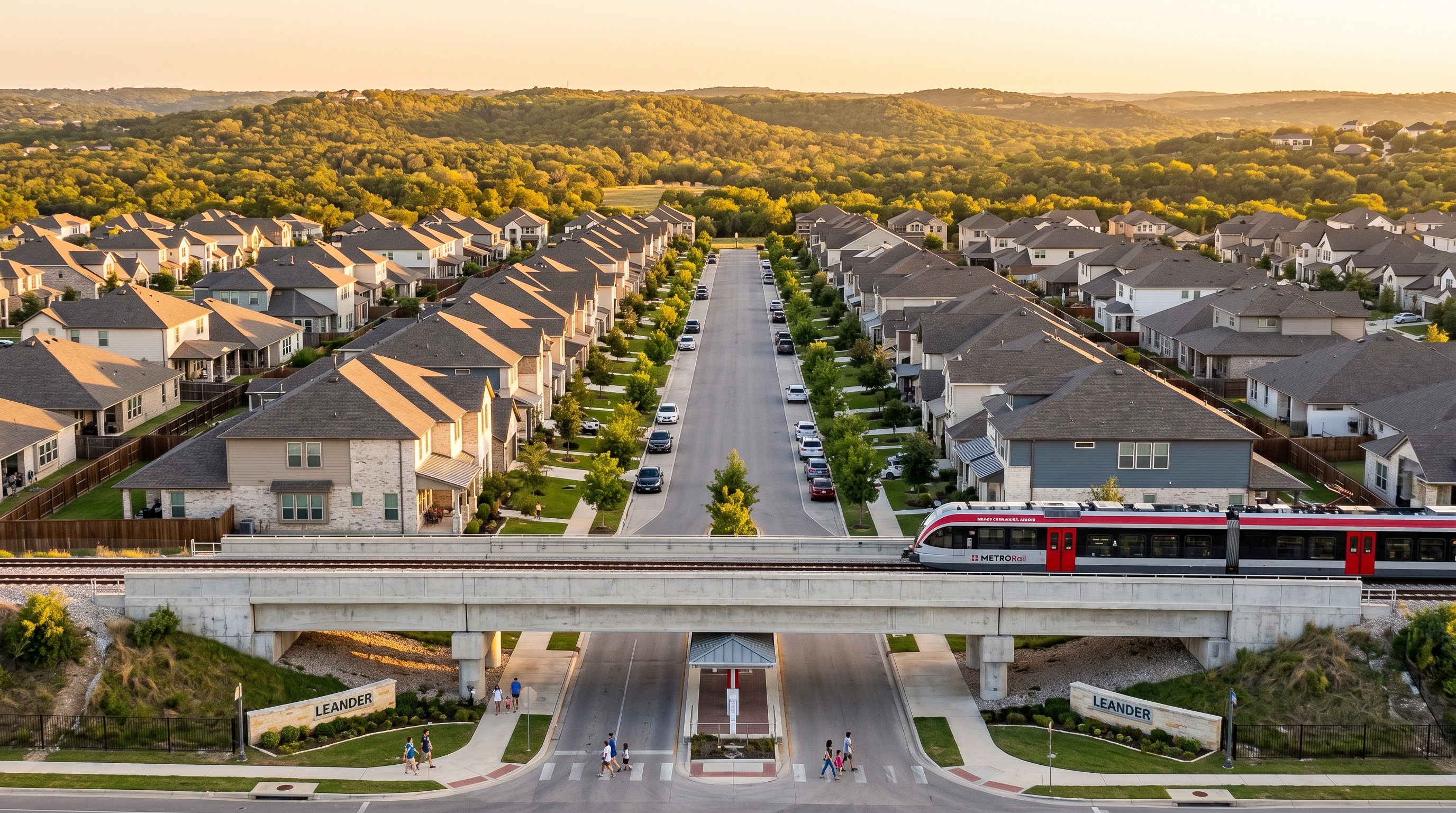
The Leander Housing Market in 2026
Leander used to be the "drive til you qualify" suburb at the far end of 183A. That's not really true anymore. The city has filled in fast, MetroRail anchors the south end of town, and new master-planned communities keep opening east toward Hutto and west into the Hill Country. The result is one of the most active new-construction markets in the Austin metro and a real choice for buyers who priced out of Cedar Park homes or want more house than they can get in town.
Here's what the numbers look like right now in ZIP 78641:
| Metric | May 2026 figure |
|---|---|
| Median list price | ~$480K–$499K |
| Median sale price | ~$450K–$485K |
| Price per square foot | $200–$215 |
| Days on market | 90–108 days |
| Active listings | 870–1,200+ |
| Typical home value (Zillow) | ~$425K–$433K |
The big story is inventory. There are still more homes for sale in Leander than at almost any point in the past five years, days on market have stretched into the 90- to 100-day range on some trackers, and builders are still discounting spec inventory and buying down rates. That gives buyers real leverage, especially on new construction. If you're tracking the broader Austin housing market trends, Leander is currently a bit softer than the metro median, which is good news if you're shopping.
The Master-Planned Communities Worth Knowing
Leander has nine or ten communities that come up over and over in buyer searches. Here's how they actually compare in 2026.
Travisso (luxury Hill Country)
Travisso is Leander's flagship luxury master plan, built primarily by Toll Brothers and Taylor Morrison. Builder pricing currently runs from the $600s into the $2M+ range, with resale inventory across that same span. The amenity center is the headline: a multi-acre complex anchored by the Palazzo clubhouse, resort-style pools, tennis, pickleball, and miles of Hill Country trails. If you want views and a country-club feel without leaving Leander ISD, this is the short list.
Crystal Falls (the big established community)
Crystal Falls is the granddaddy. It opened around 2000, now covers roughly 3,000 acres and 3,600+ homes across ten sub-neighborhoods, and has its own 18-hole golf course plus an 18-hole disc golf course, multiple pools, parks, and a stocked fishing pond. Because it's been building for 25 years, you'll see everything from sub-$500K resales in older sections to seven-figure estate homes on acreage. Great for buyers who want options at multiple price points inside one HOA.
Bryson (lifestyle programming and mid-to-upper pricing)
Bryson runs about 530 acres with builders including Chesmar, Perry, Highland, and Tri Pointe. Current inventory generally sits between the high-$300s and low-$700s. The community is known for its "Backyard" amenity center (resort pool, splash pad, lawn games), a full-time lifestyle director who programs monthly events, a stocked fishing pond, and a dog park. This is the community for families who want a real calendar of stuff to do.
Deerbrooke and Palmera Ridge (newer, mid-market)
Both are newer-build communities priced roughly in the mid-$400s and up, with modern floor plans, neighborhood pools, parks, and greenbelt access. Deerbrooke's amenity center includes a pool and fitness room. Palmera Ridge is a 426-acre master plan organized around parks and greenbelt corridors with a more contemporary aesthetic. Good fits for buyers who want new construction without paying Travisso prices.
Carneros Ranch and Sarita Valley (quieter, smaller)
Carneros Ranch is a smaller, quieter master plan with a community pool, playscape, and neighborhood park. Sarita Valley emphasizes greenbelt and creek-adjacent lots with pocket parks and trails. Both feel more residential and less resort-style, which is exactly what some buyers want.
Summerlyn and Summerlyn West (value play)
Summerlyn and Summerlyn West together cover 400+ acres and around 1,000 homes on the north end of Leander. Median prices recently ran $338K to $425K, well below the citywide median. Two parks, a pool, splash pad, playgrounds, and a walking trail. The MUD tax rate is competitive for newer Leander construction. This is where first-time buyers and budget-conscious families end up looking.
Larkspur (more house for the money)
Larkspur is technically in Liberty Hill ISD with a Leander address, but it shows up in every Leander buyer search. Current inventory generally runs from just under $300K up to the mid-$400s, with three parks, two pools, and trail connections. You typically get more square footage or more land for the price than newer in-town Leander builds, with the trade-off being a different school district and a slightly further-out commute.
Leander ISD: Schools and Ratings
Leander ISD is consistently one of the highest-rated districts in the Austin metro, profiled in our best Austin neighborhoods guide as the #2 district in the area. Niche's most recent rankings give the district an A+ overall grade and place it #2 in the Austin region. The district also earned an "A – Superior Achievement" rating on the Texas Schools FIRST financial accountability system for the 2023–24 school year, and Fitch holds the district at AA+.
Some of the standout campuses families search for:
- Florence W. Stiles Middle School, regularly ranked among the top Leander campuses, with a 10/10 rating and top 5% Texas placement on Public School Review.
- Monta Jane Akin Elementary, recently ranked top 10% statewide.
- Tarvin Elementary, frequently in the top 50 elementary schools in Texas.
- River Ridge, Laura Welch Bush, Rutledge, and Parkside Elementary, all Niche "A" rated.
- Rouse High School and Vista Ridge High School, both serve big swaths of Leander neighborhoods with strong AP and college-readiness numbers.
Attendance zones shift as the district opens new campuses, so verify the assignment for any specific address before you make an offer.
MetroRail, the Domain, and the Tech Corridor Commute
Leander Station is the northern terminus of Capital Metro's Red Line (Route 550). The 2026 schedule still runs a commuter-style pattern at Leander, with weekday southbound departures starting around 5:41 AM and headways generally in the 30- to 60-minute range depending on time of day. Trips to Downtown Station typically run about 60 to 66 minutes, with stops at Lakeline, Howard, Kramer, McKalla (Q2 Stadium), and downtown. Park-and-ride at Leander Station is free for ticketed riders.
The bigger news: CapMetro has already completed the 1.25-mile double-tracking between Leander Station and Lakeline as part of Project Connect, and a passing siding near Leander was finished in late 2022. A second double-tracking segment near Plaza Saltillo (between Attayac and Matamoros streets) is still in design with a construction timeline to be determined. Until that central Austin bottleneck is rebuilt, the all-day 15-minute headways CapMetro has talked about for Leander remain a future-state goal rather than a 2026 reality. The June 2026 service change package made no specific frequency upgrades to Route 550.
Driving times in typical 2026 traffic:
| Destination | Off-peak | Peak |
|---|---|---|
| The Domain | 25–35 min | 35–50+ min |
| Apple/Parmer tech corridor | 30–40 min | 40–55 min |
| Downtown Austin | 35–45 min | 45–60+ min |
| Tech Ridge (I-35/Parmer) | 25–35 min | 35–50 min |
If you work near a Red Line station like McKalla, Kramer, or downtown, the train can still beat driving in peak hours simply because it skips US-183 and MoPac traffic. For destinations off the rail line, you'll be driving.
Property Taxes and MUD Districts
This is the part nobody talks about until closing. Leander's total tax rate stacks five entities:
| Entity | 2026 rate (per $100) |
|---|---|
| City of Leander (FY26 adopted) | 0.434033 |
| Williamson County (2026 adopted) | 0.413776 |
| Leander ISD (most recent posted) | 1.0869 |
| MUD (varies by community) | 0.25–1.40 |
| ESD (varies) | ~0.10 |
Add it all up and most Leander homeowners land around a 2.2% to 2.8% effective rate depending on the MUD. Many homeowners in newer master-planned communities pay $1,000 to $3,000+ per year in MUD tax alone on top of city, county, and school taxes. That's the trade-off for newer infrastructure (roads, water, drainage) the developer financed up front.
Two practical tips:
- Always pull the specific MUD rate worksheet for any address you're serious about. The Williamson County Truth-in-Taxation database lists every taxing unit by parcel, and the difference between two communities a mile apart can be meaningful.
- File your homestead exemption in January after closing. Texas voters approved a permanent increase to a $140,000 school homestead exemption (with an extra $60,000 for homeowners 65 and older), which is detailed in our Austin property tax guide.
Leander vs Cedar Park vs Round Rock
The three suburbs everybody compares. Here's the honest read for 2026:
| Leander | Cedar Park | Round Rock | |
|---|---|---|---|
| Typical home value | ~$425K | ~$472K | ~$440K |
| Median sale price | ~$450K–$485K | ~$473K | ~$440K |
| Main school district | Leander ISD | Leander ISD | Round Rock ISD |
| Best commute to | Downtown via rail | Northwest/Domain | I-35 corridor |
| Inventory feel | Newer master plans | Built-out, less new | Largest selection |
| Vibe | Hill Country, growing | Polished suburban | Bigger-city suburb |
Leander vs Cedar Park: Same school district, but Leander is roughly $40K to $50K cheaper for similar square footage, with newer construction. Cedar Park has the better retail, restaurants, and a more finished feel. Pick Cedar Park if commute to the Domain matters most and you want walkable amenities. Pick Leander if you want a newer home for the money or rail access.
Leander vs Round Rock: Round Rock has the deepest inventory in the metro, with 800+ active listings in Round Rock at any given time. It's also a better commute if you work along I-35 or in the SH-130 corridor. Leander wins on Hill Country topography, newer master-planned communities, and the train.
For the bigger picture, our Austin suburbs comparison breaks down all ten major suburbs side by side. Buyers focused on the I-35 corridor may also want to compare Pflugerville homes for sale before deciding.
What $400K to $600K Actually Buys
This is the price band where most Leander buyers land. Here's the practical breakdown:
- $400K–$450K, A 3-bed, 2-bath resale in Summerlyn, older sections of Crystal Falls, or Larkspur. Typically 1,800–2,200 sqft, builder-grade finishes, MUD tax included. Some new-construction townhomes also slot here.
- $450K–$525K, The sweet spot. A newer 4-bed in Bryson, Palmera Ridge, Deerbrooke, or Carneros Ranch. 2,200–2,800 sqft, more recent finishes, full amenity access. Builder incentives often add $10K to $25K in closing credits or a rate buydown.
- $525K–$600K, Larger 4-bed or 5-bed in newer Bryson or Travisso entry sections, or a custom resale in Crystal Falls. 2,800–3,400 sqft with upgrades, often a study and game room.
- $600K+, Travisso main sections, Crystal Falls estate lots, or custom builds with Hill Country views. This is where lot premiums and view premiums kick in hard.
For broader context on what each tier buys across the metro, our Austin buyer's guide covers the same price bands metro-wide.
How to Start Your Leander Home Search
A practical sequence that works for most buyers:
- Pick 2-3 communities based on schools, commute, and amenity priorities. Don't try to tour ten.
- Pull active listings in those communities so you have a realistic baseline of what's on the market and what's been sitting.
- Drive the commute at 7:30 AM on a weekday to your actual office. Test the Red Line if it's an option.
- Get pre-approved and shop builder incentives. In 2026, Leander builders are stacking rate buydowns 1-2 points below market, $5K to $25K in closing or flex cash credits (D.R. Horton has been advertising up to $25K), and $10K to $30K in design-center credits on spec homes.
- Pull the MUD worksheet for any property you make an offer on so you know the real annual tax bill.
If you're earlier in the process and still narrowing suburbs, the new construction Austin guide covers builder incentives metro-wide, and the moving to Austin relocation guide walks through the bigger picture for out-of-state buyers. First-time buyers should also review the first-time buyer guide for down payment assistance programs.
Frequently Asked Questions
Is Leander still affordable in 2026?
Relative to Cedar Park, Bee Cave, and central Austin, yes. The typical Leander home value sits around $425K versus $472K in Cedar Park. Inventory is sitting above 870 listings in the ZIP and prices are flat to slightly down year-over-year, so buyers have leverage. It's not the bargain it was in 2018, but it's the most affordable way to get into newer Leander ISD construction with Hill Country topography.
Should I buy new construction or resale in Leander?
In 2026, new construction often wins because builders are stacking permanent and temporary rate buydowns 1 to 2 points below market, closing cost credits, and design center money that resale sellers can't match. Resale wins if you want mature trees, an established neighborhood feel, or a specific older floor plan. The price per square foot is often similar once you adjust for builder incentives.
How good are Leander ISD schools really?
Genuinely strong. Niche grades the district A+ and ranks it #2 in the Austin region, the district holds the highest "Superior Achievement" rating on Texas's financial integrity system, and Fitch holds it at AA+. Standout campuses like Stiles Middle and Akin Elementary regularly land in the top tier of Texas rankings. Not every campus is at the same level, so check the specific elementary and middle assignments for any address you're considering.
Does the MetroRail Red Line actually work for commuters?
It depends on where you work. CapMetro still runs Leander on a commuter-style schedule with 30- to 60-minute gaps, so the train works best if your office is near Downtown Station, McKalla (Q2), or Kramer. Once the central Austin double-track project finishes, full 15-minute headways become realistic, but that's not committed for 2026. Many Leander commuters use the train 2-3 days a week and drive the rest.
What MUD am I in if I buy in Travisso, Bryson, or Crystal Falls?
Each community has its own MUD with its own adopted rate, and rates change annually. Williamson County publishes a Truth-in-Taxation database that lists every taxing unit by parcel address. Always pull the worksheet for the specific subdivision before you write an offer, because two communities a mile apart can differ by 0.50 or more per $100 in valuation, which is real money on a $500K home.